May 04

May 17: Deokhyo Choi

Deokhyo Choi

(PhD Candidate, History, Cornell University)

“Racializing the Postwar Crisis: Democratization and the Making of “the Korean Problem” in U.S./Allied-occupied Japan, 1946-1947″

May 17 (Thursday), 4-6 pm.

JHF Room (SS224)

Abstract

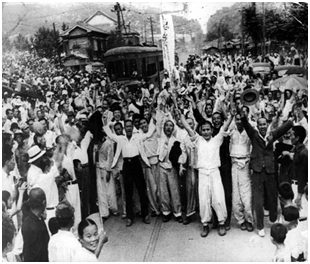
Historical accounts on “postwar Japan” have often hailed the U.S./Allied occupation and democratization of Japan as a critical historical “break” from its ancien regime.  Such conventional accounts operate upon a common temporal framework and relational binary in narrating the formation of a new democratic, “peace-loving” nation.  Recently, both English and Japanese language studies have problematized the temporal binary framework centered on the issue of continuity and discontinuity and instead have started to illuminate a long historical trajectory that straddles the wartime and postwar periods.  However, the relational binary of U.S.-Japan, another axis of the narrative framework of “postwar” history, still remains unquestioned in the scholarship.  In other words, the formation of postwar Japan is primarily understood only from the viewpoint of U.S.-Japan relations.  It is still essentially a story about U.S.-Japan(ese) direct encounters, collaborations, or “embracing.”  

            This paper challenges both the temporal and relational binaries underlying the history of postwar Japan.  Diverging from conventional historical accounts on the democratization of Japan under U.S./Allied occupation, it begins with the question of how Japan’s “postwar democracy” was forged vis-à-vis the postcolonial Korean population in former metropolitan Japan. Through an examination of post-empire “race-making” that emerged in the form of the ideological reformulation of “the Korean problem,” this paper discusses how the new Japanese nation-state was framed through the reimagining of now-liberated Korean colonial subjects in Japan as well as through the embracing of U.S./Allied occupation.
Jan 18

January 26: Monica Kim

East Asia: Transregional Histories Workshop presents:

Empire’s Babel: Making the Decolonized Subject in the U.S. Military Interrogation Rooms of the Korean War
by

Monica Kim (Korea Foundation Postdoctoral Fellow, UChicago)
Thursday, January 26, 2012
JHF (SS224), 4-6 pm

Paper Abstract:

The U.S. military interrogation room came into the purview of the U.S. mainstream public by way of the torture debate, but both critics and supporters of coercive interrogation techniques have surprisingly found common ground in one assumption regarding the interrogation room itself: that the interrogation room can be a rational space for the production of information. This article argues that the U.S. military interrogation room has historically played a critical role in the project of universalizing the vision of a U.S. liberal geopolitical order not through the production of information, but rather through the production of subjects.  Through an examination of the histories of the interrogators, the interrogated POWs, and the policies surrounding interrogation during the Korean War, this article demonstrates that the notion that the U.S. military interrogation room can be an objective space for information-gathering is actually a construct molded by mid-twentieth ideas about racial capacities, assimilation, and decolonization.

Mar 08

D Ryan Gray, Mar 12

Our last meeting of the quarter will be a joint session with the Interdisciplinary Archaeology Workshop. In place of a precirculated paper, the speaker will give a PowerPoint presentation for 30-40 minutes followed by discussion.

D. Ryan Gray
Graduate student in the Department of Anthropology
University of Chicago


“Identity and the Material Dimensions of Public and Private Practice: Archaeology of a Chinese Laundry in New Orleans

March 12 Thursday 4:00-5:30 pm
Haskell Hall Mezzanine, Room 102

Abstract:  While the lives of Asian-American immigrants in the American West have attracted considerable attention from an archaeological perspective, the subject has been little studied in the East, and even less so in the southern United States.  Excavations at the site of a laundry operated by a Chinese immigrant in New Orleans, Louisiana, between 1890 and 1920 offer an opportunity to examine the complex place occupied by Asian-Americans in a society increasingly structured by the starkly dualistic racial hierarchy of Jim Crow segregation.  Historic documents examined in this paper emphasize the often ambiguous social position of immigrant Chinese in New Orleans culture, with records demonstrating unclear and conflicting racial designations, shifting names, and domestic arrangements that seem to have violated the letter of the law.  While in the turn-of-the-century West,early Chinese immigrants appeared to have often maintained a unique or distinctive material culture, both publicly and privately, artifacts associated with the excavated laundry suggest that their counterparts in New Orleans understood the tenuousness of their position in the city.  The resident laundryman utilized items that could be characterized as Chinese only in the most private settings of his home life, part of a strategy to avoid bringing attention to any difference that, within the Jim Crow South, would have been interpreted as evidence of a racialized inferiority.  In doing so, the immigrant was able to exploit a place in the city both embedded within the fabric of the everyday but testing the possibilities of its margins.